UVXY’s five-day range sits at 9.42%. That is less than half its typical five-day range of 19.93%.
On pure range statistics, this is one of the most compressed readings UVXY has ever seen. The Squeeze Rank Tool ranks it tighter than 93% of every historical five-day window the product has ever produced. The tool labels it Extremely Tight for that reason.
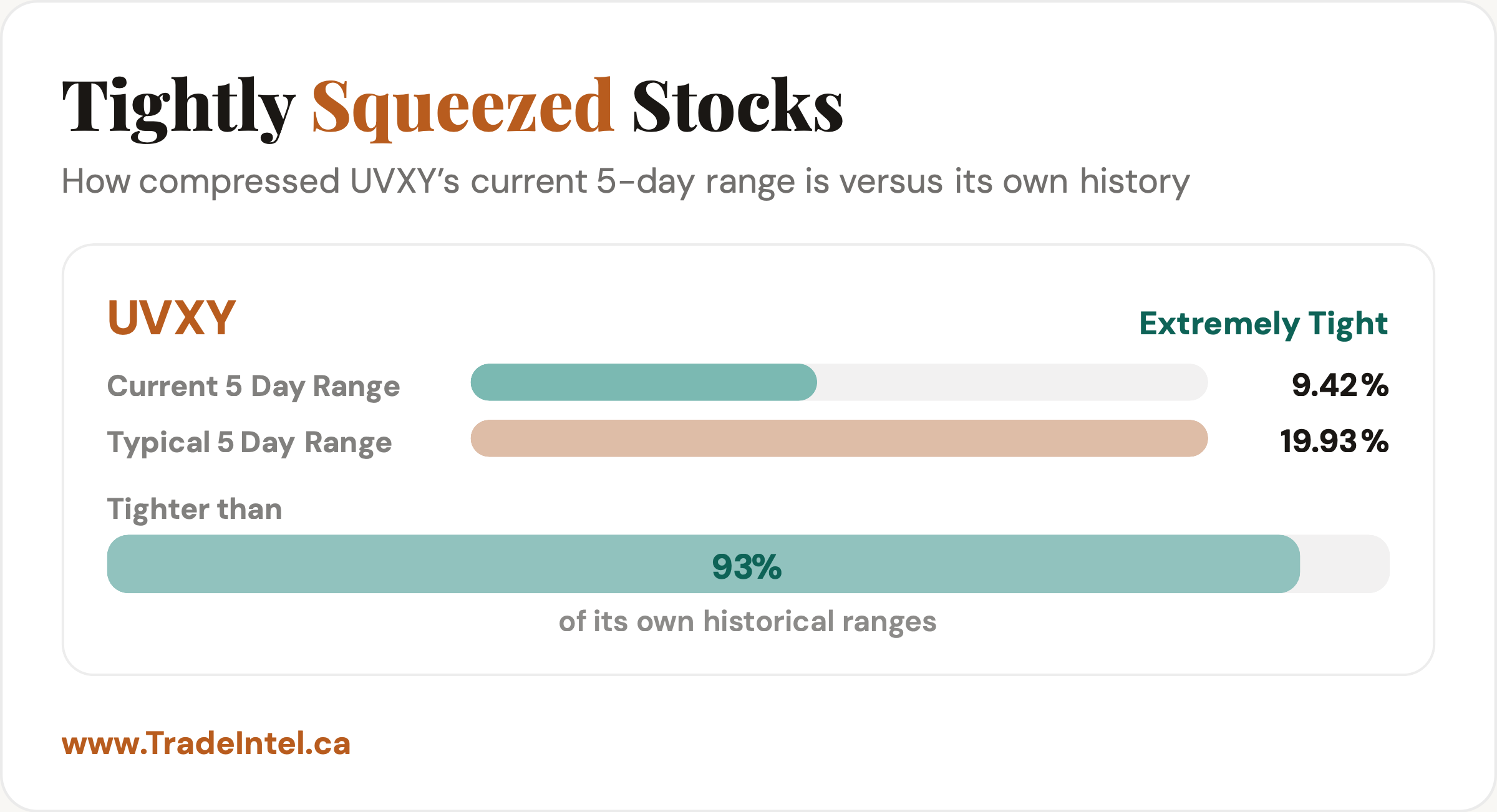
This is only the 54th time UVXY has been this coiled.
Traders love these setups. A tightly coiled volatility product is supposed to be a coiled spring. Range contraction is meant to precede expansion, and when UVXY finally moves it can move hard in either direction.
The question is whether that actually happens. The table below compares what UVXY did after these extreme tight readings against what it did on a normal day.
| Time frame | Measure | After a tight reading | After any session |
|---|---|---|---|
| Next day | Closed higher | 39.6% | 40.1% |
| Next day | Average move when higher | +3.59% | +5.88% |
| Next day | Average move when lower | −2.53% | −4.56% |
| Next week | Closed higher | 35.8% | 34.8% |
| Next week | Average move when higher | +10.23% | +13.46% |
| Next week | Average move when lower | −7.52% | −10.15% |
If you think UVXY is going to explode up because it’s coiled, the data does not support that. After extreme compressions, UVXY closed higher only 39.6% of the time the next day (versus a 40.1% baseline) and 35.8% of the time the next week (versus 34.8%). The edge is effectively zero. Worse, every average move (both up and down) came in smaller than normal. A tight five-day range was followed by a quieter next day and a quieter next week. That is the opposite of what a coiled spring is supposed to do.
The historical sample itself is scattered. Some of those 53 days produced sharp upside explosions. Others simply continued lower or chopped. The current reading sits right in the middle of that distribution. There is no clean edge that says "buy the coil" or "short the coil" with high confidence.
Range compression is a real observation on stocks, but UVXY is not a stock. It is a 1.5x short-term VIX futures product with a built-in negative drift most of the time. Contango, roll costs, and the structural decay of volatility products do not pause just because the recent five-day range got quiet. A tight range inside a decaying instrument is still a decaying instrument.
Comments
Loading comments…