Most traders sell options, set stops, or pick targets on instinct. "SPY won't drop 2% today, that's rare." Maybe. But how rare is rare?
The honest answer needs three things you usually don't have on hand: the historical frequency at that move size, the same number for the actual holding period you're trading (a week of 2% moves is very different from a day of 2% moves), and the same number again filtered to the volatility regime you're in. Calm markets and panicked markets produce completely different probabilities.
The Probability Lab
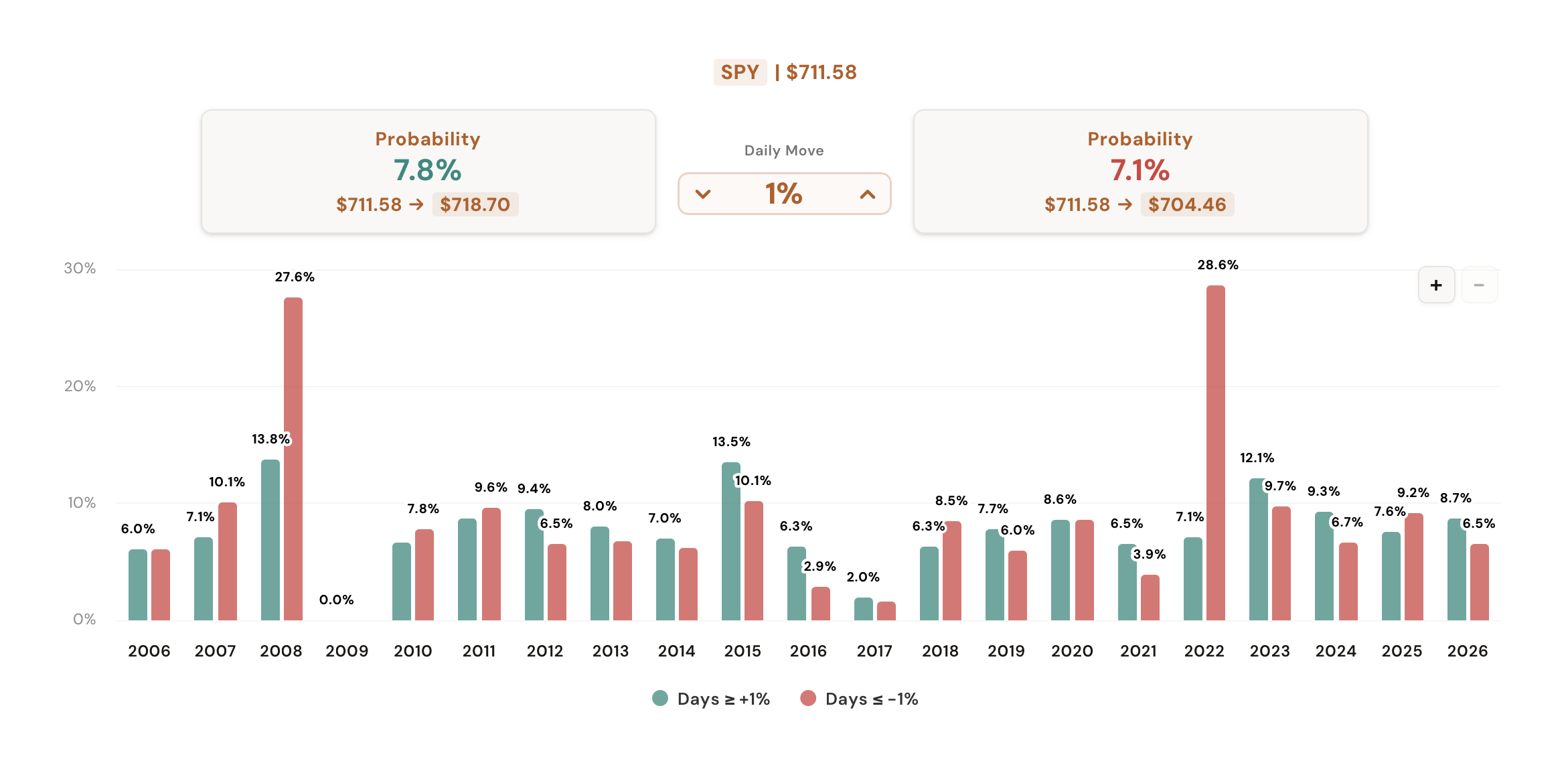
Pick a ticker, set a threshold, hit go. Two cards above the chart give you the exact answer: Probability ≥ +N% and Probability ≤ -N%, each as a percentage of historical periods plus a live price target: current price → up or down side at that move. Below them, a column chart breaks the same probabilities down year by year so you can see whether the read is stable, trending, or fading.
Three controls reshape the answer. Period swaps Daily / Weekly / Monthly so you're measuring the holding period you actually trade. VIX Regime filters historical periods to only those that opened with VIX under 20, between 20 and 30, or over 30 (calm markets, normal markets, panicked markets, all separate populations). Filter By switches between two definitions of "moved": Close (where the period ended) and Touch (whether the high or low ever reached your threshold intraperiod).
Comments
Loading comments…